

 Don Moss
 Monty Turner
Navigating the New Standard: Incentives Are No Longer Automatic
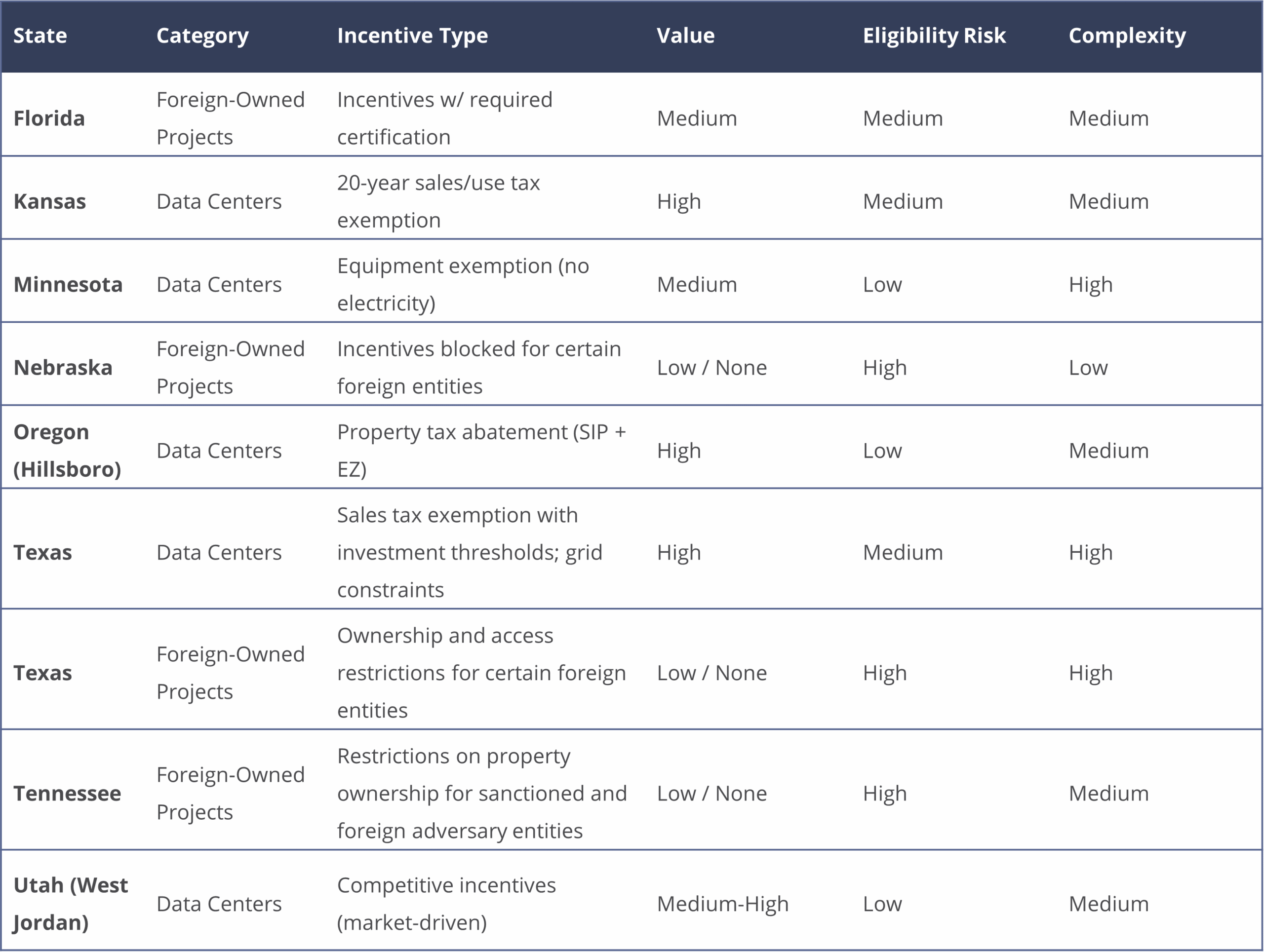
For years, economic incentives for data centers and large-scale industrial projects followed a fairly predictable path. That’s no longer the case. The landscape has shifted, with states introducing stricter eligibility criteria, performance requirements, and compliance obligations that can materially impact deal viability.
Incentives are no longer a late-stage benefit. They are an early-stage risk factor.
Policies are evolving quickly across key markets, from tightened infrastructure and foreign ownership rules to outcome-based incentive structures. What qualifies today may not qualify tomorrow, and missteps early in the process can delay or even derail a project entirely.
Engaging the Economic Incentives team early is critical. They can help navigate shifting requirements, identify risks upfront, and structure deals in a way that preserves eligibility and avoids costly surprises down the line.
The sections that follow highlight select changes across key states to illustrate how this landscape is evolving, but they are not exhaustive of all programs or jurisdictions.
Key Takeaways
- Incentives remained available in 2025, but they’re more conditional. Many states are shifting emphasis from headline dollars to eligibility screens, operating requirements, and ongoing compliance.
- Data centers are the clearest example. Incentives are increasingly paired with requirements tied to power impacts, workforce standards, and reporting/verification.
- For foreign-owned or foreign-controlled entities, the negotiation is increasingly preceded by a gating question: “Are we eligible at all?”
Data Centers: The Shift Toward Conditional Compliance
States continue to compete aggressively for hyperscale and enterprise data center investment. At the same time, policymakers are responding to mounting concerns around energy demand, grid planning, and ratepayer impacts, with incentives increasingly designed to reflect those realities. ¹
Utah (West Jordan): Hyperscale Development
Early hyperscale development in West Jordan, Utah, helped establish the Salt Lake Valley as a competitive data center market. The flagship campus development represented more than $1 billion in initial announced investment, later expanding to approximately $2 billion in total capital investment for the 100-acre data center campus. ²
The project supported the region’s emergence as a western U.S. data center hub while generating significant construction employment and high-skill technology jobs.
Oregon (Hillsboro): Enterprise Zone and Strategic Investment Program
In Hillsboro, Oregon, the state’s Enterprise Zone and Strategic Investment Program (SIP) created a personal property tax abatement structure that significantly lowered the tax burden on data center equipment. ³
Hyperscale projects in the market frequently exceed $500 million to $1 billion in capital investment, and the tax programs can reduce taxable value by hundreds of millions of dollars, which can translate into tens of millions in tax savings during the early years of operation. ³
These policies helped accelerate Hillsboro’s emergence as a major western U.S. data center hub.
Kansas: Expansion with Defined Thresholds
Kansas enacted a 20-year state and local sales and use tax exemption for qualifying data centers under Senate Bill 98.
Eligibility is tied to clear thresholds, including at least $250 million in eligible data center costs by the fifth year of operations, and creation and maintenance of at least 20 new jobs within two years after operations commence.⁴
The exemption applies to qualified construction, equipment purchases, and related costs associated with the data center facility.⁴
Minnesota: Program Rebalanced Toward Electricity Treatment and Workforce Standards
Minnesota’s data center incentive program continues to provide exemptions for qualifying IT equipment and software used in large-scale facilities. ⁵ However, official guidance clarifies that electricity purchases will no longer qualify for exemption beginning July 1, 2025.⁵
The program also applies prevailing wage requirements to laborers and mechanics constructing or refurbishing qualifying data centers tied to the exemption. ⁶
Texas: High-Value Incentives with New Upfront Costs
Texas continues to offer a state sales tax exemption for qualifying data centers under the Data Center Sales Tax Exemption program. Eligibility requires a minimum of $200 million in capital investment and the creation of at least 20 qualifying full-time jobs within five years. ¹⁰
However, evolving grid and infrastructure requirements are introducing new upfront cost considerations. Proposed interconnection standards (implementing SB 6) would require large-load projects exceeding 75 MW to pay a non-refundable $50,000/MW fee and post equivalent financial security. ¹¹ These dynamics are shifting early-stage economics, making power availability and upfront capital requirements key factors in site selection.
What Does This Signal for 2026?
In many jurisdictions, incentives are evolving from one-time inducements to lifecycle commitments, with terms and conditions that can influence project schedules, procurement decisions, and long-term operating economics. ¹
Legislative activity around data centers has accelerated significantly as governments respond to the rapid growth of cloud computing, artificial intelligence, and high-density digital infrastructure.
Foreign-Owned Projects: Eligibility Becomes the Incentive Question
For foreign-owned or foreign-affiliated companies, the 2025 landscape increasingly emphasizes front-end diligence on ownership, control, and covered-entity status, often before incentive negotiations begin. ⁷
Nebraska: Bright-Line Ineligibility
Nebraska guidance states that “foreign adversarial companies” are prohibited from receiving benefits from certain state incentive programs, effective October 1, 2025.⁸ Please note that state restrictions on “foreign adversarial companies” are still evolving.
Florida: Certification Requirement Before Incentives
Florida law requires an affidavit signed under penalty of perjury before a government entity may provide an economic incentive. The affidavit must certify that the applicant is not a covered foreign entity under the statute. ⁹
Tennessee: Expanding Restrictions on Foreign Ownership
Tennessee has expanded restrictions on foreign ownership of real property, targeting entities tied to sanctioned or designated foreign adversary nations, with ongoing regulatory evolution in enforcement and interpretation. The law introduces eligibility limitations, disclosure requirements, and enforcement mechanisms that may restrict or prohibit certain transactions.
Texas: From “Policy” to “Enforcement”
Texas has expanded restrictions on foreign-owned projects under SB 17 and related legislation, limiting property ownership, leasing, and access to critical infrastructure for certain foreign entities. ¹³ Under current statute, penalties for non-compliance can reach the greater of $250,000 or 50% of the property’s market value, along with potential court-ordered divestment.
Proposed rules, if adopted, would expand enforcement expectations for real estate professionals, increasing compliance risk and reinforcing the need for early eligibility review.
Practical Impact
For some investors and operators, incentive eligibility has effectively become a diligence stream comparable to environmental review, land use approvals, and utility feasibility.
The risk is no longer simply receiving a reduced award, but losing access to incentives entirely or requiring changes to ownership or deal structure to maintain eligibility.
How Conditionality Shows Up in Real Deals
While details vary by program and state, 2025 deal structures increasingly included:
- Eligibility screening up front
(thresholds, certifications, covered-entity restrictions) - Ongoing compliance obligations
(reporting, verification, audit-ready documentation) - Performance linkage
(requirements tied to jobs, investment, and operational parameters)
Implications for Site Selection and Expansion Strategy
Move incentives diligence earlier.
Screen incentive eligibility alongside power strategy, land control, permitting, and ownership/control review.
Model compliance costs — not just benefits.
Electricity treatment and workforce requirements can materially alter operating cost forecasts and construction budgets.
Treat incentives as a lifecycle workstream.
Certifications, documentation, and compliance checkpoints can affect both project timelines and execution planning.
Talking Points
- Location strategy and incentive strategy are now inseparable. Misalignment between the two can directly affect a new site’s profitability.
- While incentives remain broadly available in 2025, approval risk and compliance exposure have increased, making early structuring and documentation critical.
- State and local programs increasingly emphasize defensibility, statutory compliance, public scrutiny, and measurable economic impact.
- Companies and their leadership should evaluate incentives not simply as financial upside, but as a component of regulatory risk management and long-term operating economics.
- Incentive eligibility has become a threshold issue in many jurisdictions for certain foreign ownership structures.
Bring in Economic Incentives Early
Given the increasing role of eligibility screening and compliance requirements, brokers should include the Economic Incentives team early to confirm qualification and avoid disqualifying issues later in the deal process. In some cases, failure to validate eligibility early can result in full loss of incentives or forced restructuring of ownership. Contact Monty Turner or Don Moss to evaluate eligibility and structure incentives.
Disclaimer: This is a high-level, directional overview. Incentive eligibility, structure, and outcomes vary by deal and are subject to change. Do not rely on this as a substitute for deal-specific analysis. Include the Economic Incentives team early to validate eligibility and avoid disqualifying issues.
Sources
- National Conference of State Legislatures (NCSL) – Subsidizing Servers: How States Are Competing to Attract Data Centers
- Utah Governor’s Office of Economic Opportunity – Data Center Industry in Utah / Silicon Slopes Growth
- Oregon Business Development Department – Strategic Investment Program (SIP) and Enterprise Zone Incentives
- Kansas Legislature – Senate Bill 98: Data Center Sales Tax Exemption (2025)
- Minnesota Department of Employment and Economic Development – Data Center Sales Tax Exemption Program Guidance
- Minnesota Statutes § 297A.68 – Data Center Exemptions and Construction Labor Standards
- U.S. Department of the Treasury – Committee on Foreign Investment in the United States (CFIUS) Guidance
- Nebraska Department of Economic Development – Foreign Adversarial Company Restrictions on State Incentive Programs
- Florida Statutes § 287.138 – Prohibition on Economic Incentives to Foreign Countries of Concern
- Texas Comptroller of Public Accounts – Data Center Sales Tax Exemption Overview and Requirements
- Public Utility Commission of Texas – Proposed Interconnection Standards for Large Loads (SB 6 Implementation)
- Duane Morris LLP – New Texas Law and Proposed Attorney General Rules Restricting Foreign Ownership of Real Estate
- Texas Legislature Online – SB 17: Relating to the Prohibition of Certain Foreign Ownership and Access to Critical Infrastructure

 Joe Fetterman
 Jeffrey Myers
 David Burden
 Frank Petz
 Marianne Skorupski
 Mike Mixer
 Amel Benha
 Juan E. Rose III
 Matt Stater