

 Craig Hurvitz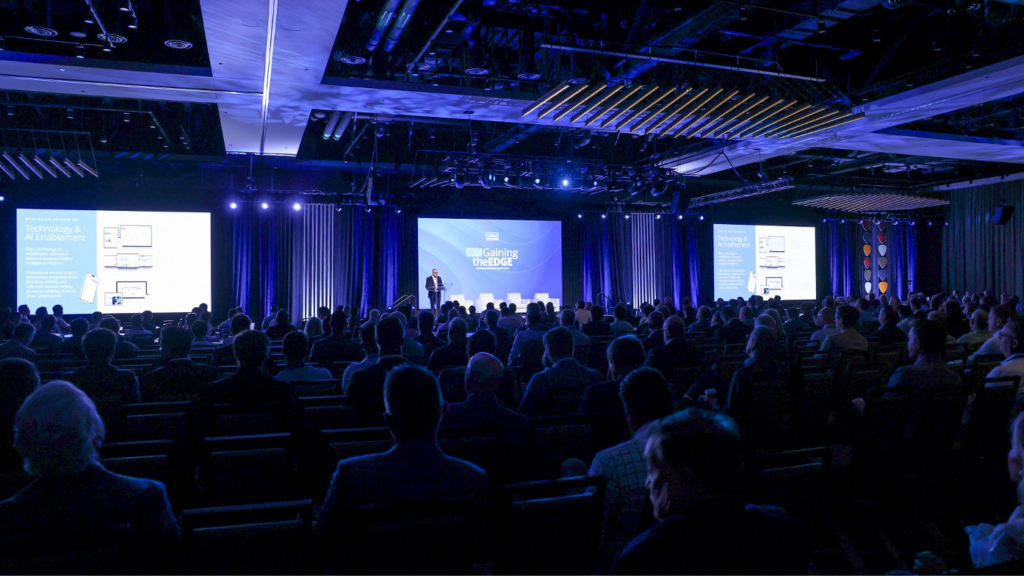
Colliers’ 2026 National Industrial Conference brought almost 900 industrial real estate professionals, clients, and industry leaders together in Nashville to explore the forces shaping the next phase of the industrial market. Throughout the events, discussions focused on the market’s transition toward the next growth cycle, shifting occupier and supply chain strategies, emerging sources of demand, disciplined investment, and the growing role of AI. Together, these themes reinforced that success in the next industrial cycle will depend on informed decision-making, strategic positioning, and strong industry connections.
Welcome to Nashville
Ryan Wood welcomed the audience to Nashville, tracing the city’s fast transformation into a major logistics, manufacturing, and technology hub driven by population growth and corporate relocation. Major economic milestones included large corporate moves and expansions, such as Amazon, and advanced manufacturing and tech-related investments that accelerated regional growth. The industrial market narrative emphasized constrained supply, low vacancy levels around 5%, and sustained demand supported by population growth and manufacturing activity. Investment confidence was reinforced by strong rent growth, rising development activity, and cap rates that remain below national averages, signaling long-term investor optimism in Nashville’s industrial fundamentals.
The Occupier Perspective: Space, Strategy, and the Bottom Line
Moderated by Colliers’ Kyle Back, this session explored how manufacturing, logistics, and retail occupiers are reshaping their real estate portfolios amid uneven market conditions, changing demand patterns, and growing pressure for network efficiency. Across sectors, companies are balancing customer-driven growth with constraints in labor, infrastructure, and real estate availability, while focusing more heavily on optimizing existing portfolios. Strategies range from consolidating overlapping or underutilized facilities to expanding distribution capacity in step with customer and store growth, with speed to market and operational flexibility becoming increasingly important.
The discussion also highlighted the close connection between real estate decisions and broader supply chain strategy. Production requirements, customer proximity, transportation efficiency, and long lead times for new facilities can limit flexibility and require companies to make the most of existing assets or pursue interim solutions as networks evolve. AI is also beginning to streamline administrative work, reporting, and data and financial analysis, but the panel emphasized that negotiations, landlord relationships, and strategic decision-making remain fundamentally human-driven. Overall, occupiers are taking an increasingly disciplined approach to their portfolios, seeking greater efficiency and flexibility while positioning their networks to support future growth.
Supply Shock to Strategic Reset: Positioning for the Next Industrial Cycle
Colliers’ Craig Hurvitz framed the industrial real estate market as entering a new growth cycle in which performance is less about speed and more about positioning. He described how the post-pandemic surge in demand was followed by an oversupply phase that pushed vacancy up. Conditions are now rebalancing as demand and new supply move back into alignment, and vacancy begins to compress again. He emphasized that regional performance varies significantly, with inland markets such as Nashville, Chicago, Dallas, and parts of the Midwest and Southeast entering the recovery phase earlier, while coastal markets lag. He also highlighted improving but still uneven fundamentals across subleasing, development activity, and sector demand shifts, including stronger roles for manufacturing, construction-related users, and data-center-adjacent demand, while rent growth has recently flattened but is expected to re-accelerate in the next cycle.
Colliers’ Steig Seaward examined the capital markets side of the equation, where elevated interest rates continue to influence pricing, liquidity, and investment decisions. Despite the higher-rate environment, industrial remains a favored asset class, with transaction volume recovering and institutional investors, including REITs, becoming more active as pricing and fundamentals stabilize. Capital remains available, but investment activity is increasingly disciplined as buyers and sellers work toward greater price alignment. Together, Hurvitz and Seaward presented a market transitioning from correction toward a more balanced growth cycle, supported by improving fundamentals, renewed capital activity, and structural demand drivers. The central message was that success in the next phase will depend less on rapid expansion and more on strategic positioning across markets, assets, and emerging sources of demand.
Keynote: Soaring to High Performance
The keynote featured former Blue Angels lead solo pilot John “Gucci” Foley, who drew on his experience flying high-performance military aircraft to illustrate how elite teams operate under extreme pressure. Central to this performance model is a disciplined cycle of preparation and execution built on briefing, alignment, and debriefing practices that drive continuous improvement and shared accountability across the team.
Foley also focused heavily on mindset, describing the “Glad to be Here” philosophy as the foundation for high performance, where gratitude, purpose, and presence reset how individuals show up each day. He linked this mindset to stronger team cohesion, faster learning cycles, and measurable performance improvements over time, including significant gains within short 90-day cycles.
The Shifting Supply Chain
Moderated by Stephanie Rodriguez, this panel brought together perspectives from a global 3PL and Chinese and Latin America market experts to discuss how global supply chains are being reshaped by geopolitical and trade realignment. A central theme was the ongoing shift from China-centric sourcing toward a broader “China+1” strategy, with Mexico emerging as the United States’ largest trading partner and a critical hub for advanced manufacturing and electronics flows. Speakers emphasized that while China-origin shipments to the U.S. have declined, overall Asia-to-U.S. trade volumes have remained relatively stable as production shifts to countries such as Vietnam and India, indicating that supply chains are being rerouted rather than reduced. At the same time, growing scrutiny around transshipment through Mexico and persistent tariff regimes are pushing firms toward more formalized regional manufacturing footprints rather than simple pass-through logistics models, reinforcing a longer-term structural move toward Western Hemisphere and allied-country sourcing.
From a real estate and logistics perspective, the discussion highlighted how these trade shifts are translating into tangible demand for industrial space, transportation infrastructure, and data center-adjacent development. Asian 3PLs are expanding rapidly into North America and Latin America, driven by thinner margins at home and higher profitability abroad, with strong leasing activity concentrated in large-scale warehouse requirements. The panel also underscored the growing importance of advanced manufacturing clusters across Texas, the U.S. Sunbelt, and key Mexican corridors such as Monterrey–Laredo. In parallel, data centers were identified as a major structural tailwind, creating downstream ecosystems of suppliers and reinforcing location advantages tied to power availability and digital infrastructure.
Capital in Motion: The Outlook for Industrial Investment
This panel, hosted by Colliers’ Michael Kendall, explored how shifting capital markets, structural demand drivers, and emerging technology are reshaping investment strategy across U.S. industrial real estate. Higher interest rates and persistent inflation have forced investors to recalibrate financing assumptions, exit cap rates, and risk, while greater divergence in liquidity has placed a premium on high-quality, well-located assets. Despite these macroeconomic pressures, industrial demand remains resilient, supported by emerging sources of growth including data center-adjacent activity, defense technology, and advanced manufacturing. The discussion highlighted data center-adjacent demand, with an estimated 15% of leasing activity tied to adjacent uses in some high-growth data center markets.
Against this backdrop, investment strategies are becoming increasingly disciplined, with basis and replacement cost serving as critical benchmarks for acquisition and disposition decisions. The panel also examined AI’s growing role in accelerating underwriting, reporting, data analysis, and site evaluation, as well as its potential to create broader structural changes across the economy. At the same time, entitlement challenges, zoning constraints, competition for land from data centers, and geopolitical uncertainty are adding complexity to investment decisions and potentially limiting future supply in some markets. The overarching message was clear: amid continued uncertainty, successful industrial investment will increasingly depend on disciplined pricing, asset quality, and the ability to identify the demand drivers and markets best positioned for the next phase of growth.

 Shawn Machado