 Rachael Rothman

Commercial real estate capital is available, but financing outcomes increasingly depend on the asset, basis, borrower, market and business plan.
Colliers Capital Markets recently sat down with Matthew G. Rocco, President, Debt & Structured Finance at Colliers, to discuss what lenders are rewarding, what works at today’s cost of capital and why basis, cash flow and capital structure remain critical to a resilient investment strategy.
Colliers Capital Markets (CCM): How would you characterize the CRE financing market today?
Debt & Structured Finance (D&SF): The CRE debt and equity markets are liquid, but highly selective. CRE is not a single, uniform sector. It is contextual. Individual assets, borrowers and markets must be underwritten and priced according to specific risk and return objectives.
Banks, life companies, agencies, CMBS and CLO lenders, and private credit providers are all active. However, assets, borrowers and markets that demonstrate durable cash flow, strong sponsorship, and a defensible business plan will receive the most competitive terms.
For high-quality multifamily, industrial, grocery-anchored retail, and other assets with durable cash flow, we can create meaningful competition among lenders, and spreads remain tight. Capital may also be available for Class B office, challenged hospitality and challenged multifamily, as well as assets with substantial capital needs, but the leverage, pricing, reserves and recourse will look very different.
Two properties with the same appraised value can therefore produce dramatically different financing outcomes. A stabilized asset with durable NOI and strong sponsorship may support conventional senior debt at attractive terms. A property with rollover, capital-expenditure or lease-up risk may instead require a lower-leverage senior loan combined with preferred equity or mezzanine capital.
Capital is available for both, but it is being priced much more precisely to the underlying risk.
CCM: How has this cycle changed lender behavior?
D&SF: Lenders are much more focused on the durability of cash flow and protection against downside risk. The recent cycle reminded the market that a low loan-to-value ratio based on an aggressive valuation does not necessarily represent low risk.
Today, lenders are paying closer attention to debt yield, in-place debt-service coverage, tenant rollover, sponsor liquidity, required capital expenditures and the amount of fresh equity in the first-loss position.
Lenders will stretch for the right combination of asset quality, basis, market, and sponsorship. They are much less likely to stretch when one or more of those factors is absent.
CCM: What works at today’s cost of capital?
D&SF: Transactions and investment strategies that do not depend on artificially low interest rates.
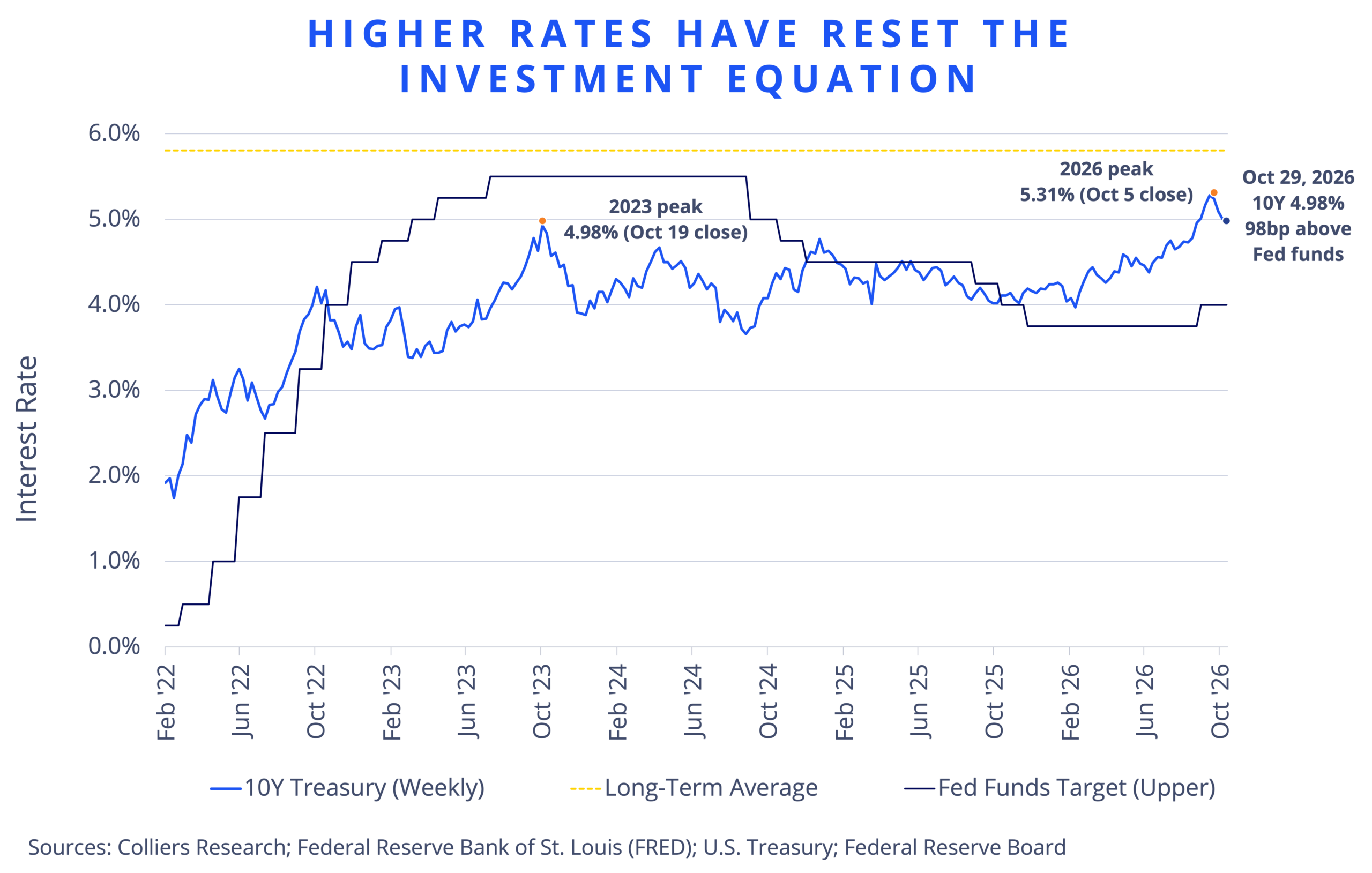
We have returned to something closer to the historical norm for borrowing costs. Investors must now generate returns through net revenue and execution rather than relying primarily on cap-rate compression.
Buying at current fair value and establishing the right basis can compensate for the higher cost of debt because the investor is no longer paying yesterday’s price and hoping for tomorrow’s interest rate.
The key question has shifted from, “When will rates fall?” to, “Can I earn an acceptable return if rates stay around here?” If the answer is yes, the investment thesis is much more resilient.
CCM: Is the maturity wall becoming a catalyst for activity?
D&SF: Yes, although I would describe it as a series of maturity waves rather than one maturity wall.
The industry has spent several years extending loans, modifying structures and giving good borrowers time to adjust. That was rational because immediately forcing assets into the market would not necessarily have maximized value for lenders or borrowers.
However, an extension addresses a timing problem. It does not necessarily solve an underlying capital-structure problem.
As loans reach their extended maturities, more owners must decide whether to contribute fresh equity, refinance at lower proceeds, bring in a new capital partner, or sell.
Many loans originated over the past several years, as well as many being originated today, have three- to seven-year terms. That is creating approximately $850 billion of annual CRE maturities, with maturity waves likely to continue for many years.
CCM: What can we relearn from prior cycles?
D&SF: CRE is management- and capital-intensive, and illiquid. We need “tourist” CRE investors to find other investments and let true CRE investors help stabilize the market.
The transactions that tend to survive difficult cycles have several characteristics in common: appropriate leverage, adequate liquidity, multiple ways to create value and enough time to execute the business plan.
The deals that get into trouble usually have very little margin for error. They combine aggressive leverage, optimistic NOI growth, and an exit value that assumes cap-rate compression.
A sound investment should not require every assumption to go right.
CCM: Does real estate still earn its complexity?
D&SF: It can, but investors must be adequately compensated for that complexity.
Real estate is illiquid and requires capital, management, and execution. If an investor can earn an attractive return in liquid fixed income with relatively little operating risk, owning property should offer something more: a higher expected return, inflation protection, a compelling basis, or a clear opportunity to create value.
That does not mean applying an arbitrary premium to every transaction. A core institutional multifamily asset and a transitional office redevelopment should have very different return hurdles.
The important question is whether the expected return adequately compensates the investor for illiquidity, leverage, leasing, capital expenditures and execution risk.
One of today’s most interesting opportunities is that the reset in basis can give investors something they did not have several years ago: the ability to acquire good real estate below replacement cost or below a previous owner’s basis.
That can provide a meaningful margin of safety, provided the buyer fully understands the capital required to operate and improve the asset.
CCM: How do shorter capital plans change the investment equation?
D&SF: The industry has become much more focused on three- to seven-year capital plans. Some of that reflects fund structures and investor expectations, and some reflects continuing uncertainty around interest rates and valuations.
The danger is trying to force a long-duration real estate strategy into a short-duration capital structure.
The better approach is to match the duration of the capital to the duration of the real estate strategy while preserving optionality.
If an investment works in year three, but the capital allows you to hold until year seven, you can sell when the market rewards you rather than when the capital structure forces you.
CCM: What are we going to wish we had recognized sooner?
D&SF: Investment markets remain highly correlated, including strategies tied to the S&P indexes and private credit. Commercial real estate differs meaningfully from many other income-oriented investments. It is a long-term, capital-intensive, management-intensive, and illiquid asset class.
Many CRE equity investments made between 2020 and 2023 are now worth materially less than the capital initially invested. For some vintage assets, investors may recover only half of their original equity. Today’s investors need to focus on basis and business plans rather than building an investment thesis around a forecast for interest rates.
The strongest opportunities will belong to investors who can acquire assets at a defensible basis, capitalize them appropriately, and remain patient enough to let the real estate strategy work.
A rate call is not an investment thesis. Lower rates may help, but the investment should not require them.
Colliers Debt & Structured Finance delivers tailored financing solutions, connecting clients with the right capital source – across agency, bank, life company, and debt fund executions. Click here to learn more.