 Anjee Solanki
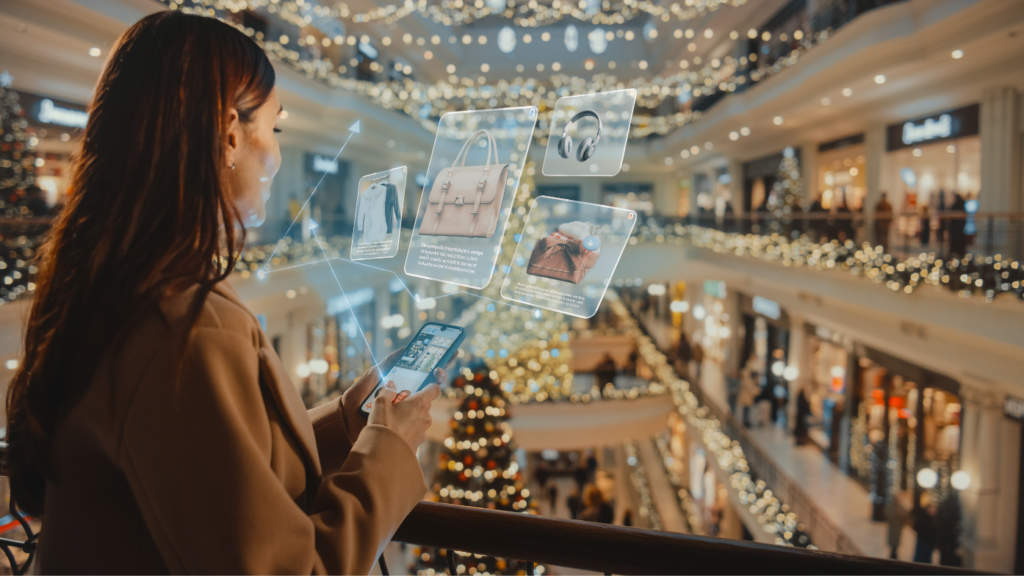
Retailers have long competed for holiday spending, using everything from gift guides and Black Friday doorbuster deals to personalized recommendations to influence where and how consumers shop.
Beyond suggesting what to buy, AI technology is evolving into a personal shopper: comparing options, tracking prices, and, with permission, completing purchases for consumers. As consumers increasingly delegate shopping decisions to AI, retailers may find themselves competing not just for shoppers’ attention, but for an algorithm’s recommendation. Price, availability, delivery speed, and convenience could become more influential in determining which retailer ultimately wins the sale.
With 65% of shoppers surveyed in Shopify’s 2026 Global Holiday Retail Report expecting to use AI for at least one shopping task, the commerce platform has deemed 2026 the first “agentic” holiday season.
Retailers and commerce platforms have already begun introducing AI features to help shoppers manage their holiday budgets and get more for their money. Each has its own playbook for moving shoppers from recommendation to transaction. Here’s a look at what Target, Walmart, Louis Vuitton, Amazon, and Shopify are rolling out.
Target is making holiday shopping more intuitive with “Ask Target,” a beta AI assistant on Target.com and the Target app that helps shoppers find gifts, build wishlists, and narrow their choices. AI Photo Search lets shoppers use images of items they spot in the real world to find luxe-for-less alternatives to designer clothing, furniture, and home decor. These tools complement more than 8,000 new gifts, over half exclusive to Target, pairing easier discovery with an assortment that reinforces the retailer’s treasure-hunt appeal.
Walmart is building on AI-powered search and chatbots with tools that let consumers delegate purchases to AI agents. Its Agent Profiles, announced October 21, will let customers authorize individual agents, track their purchases separately, and decide how much purchasing authority to grant. Working in tandem with Agent Profiles, the Walmart Agent Gateway is in development to connect third-party AI agents directly with Walmart and Sam’s Club shopping systems, beginning with a beta for companies and developers. Alongside Walmart’s in-app assistant, Sparky, these tools position the retailer to capture purchases wherever shoppers begin their search, while giving consumers control over which shopping decisions to delegate. As AI agents become intermediaries between shoppers and retailers, the ability to appear in their recommendations could emerge as a new competitive battleground.
Retailers are not opening every door to autonomous shopping. As The Wall Street Journal reports, QVC welcomes shopping agents, while Kate Spade allows them to browse but not complete purchases. Helping shoppers discover products and authorizing an outside agent to transact are separate decisions, with retailers setting different boundaries around the customer relationship.
Luxury’s agentic AI challenge goes beyond discovery
Luxury brands are also working to shape how AI influences shopping decisions. Dior is collaborating with Bluefish, an agentic marketing platform that monitors how brands appear across AI platforms and identifies opportunities to improve their visibility and accuracy. The partnership focuses on generative engine optimization (GEO), helping Dior strengthen its representation as consumers increasingly turn to AI for answers and recommendations.
Louis Vuitton is taking a complementary approach with a ChatGPT-integrated app, bringing its brand experience into conversational discovery. Although these initiatives address how consumers discover luxury through AI, brands face the challenge of conveying the distinctive service and brand experience luxury shoppers expect through the data and content that inform AI recommendations.
Amazon brings the shopping conversation closer to checkout
Amazon is connecting conversational shopping with tools that help consumers act on price preferences and advertisers reach shoppers closer to purchase. Shoppers can receive price alerts or ask Alexa+ to monitor an item and buy it when their price conditions are met. Advertisers, meanwhile, can use Sponsored Products and Sponsored Brands prompts in shopping results and on product pages to open conversations in Alexa for Shopping, answering questions and guiding purchase decisions. Amazon reports that shoppers who click a prompt convert 48% more often and spend 21% more on average than those who do not, though the comparison does not establish causation.
What agentic AI could mean for Black Friday and Cyber Monday
Black Friday is losing exclusivity, not relevance. Adobe forecasts U.S. online sales of $12.9 billion on Black Friday, up 9.2%, and $15.1 billion on Cyber Monday, up 6.2%, with Cyber Week reaching $47.5 billion. Cyber Monday remains the bigger day, but Black Friday is narrowing the gap.
The hunt for value is giving AI shopping tools a timely role. YouGov found that planned AI use among likely Black Friday and Cyber Monday shoppers has more than doubled, from 16% last year to 34% in 2026. Finding the best price ranks as the leading use case among shoppers using or considering AI for the events. Price-monitoring agents could extend that search across the promotional season, acting when an offer meets a shopper’s conditions rather than waiting for a particular date.
As AI agents continuously monitor prices and execute purchases when predetermined conditions are met, the traditional urgency surrounding Black Friday and Cyber Monday could begin to fade. Rather than concentrating purchases around major promotional events, consumers may increasingly rely on AI to identify the best time to buy throughout the holiday season, potentially reshaping retailers’ promotional calendars.
The physical network behind the digital sale
An AI shopping agent may never evaluate a warehouse (yet) or visit a store, but the inventory and delivery options it compares depend on both. Commercial Property Executive reports that agentic shopping could intensify demand for fulfillment facilities closer to consumers, as availability and delivery speed become more influential in purchase decisions. A lower price offers little advantage if delivery options cannot meet the shopper’s needs for timing and convenience.
This raises an intriguing possibility for commercial real estate: Could store location become an AI ranking factor? If shopping agents increasingly prioritize product availability, same-day pickup, and delivery speed, retailers with strategically located stores and distribution centers could gain a competitive advantage that extends well beyond traditional foot traffic and visibility.
Real estate becomes a supporting actor in how retailers deliver on their promises to customers. Fulfillment infrastructure could increasingly serve as a customer-acquisition channel if its performance helps determine which retailer an agent recommends. For store networks and industrial facilities alike, the emerging connection is between where inventory sits, how quickly it can reach the shopper, and who wins the sale.
In an increasingly AI-driven retail landscape, the value of a store may no longer be measured solely by the customers who walk through its doors, but also by the digital transactions its location helps secure.


 Nicole Larson