

 Franklin Wallach
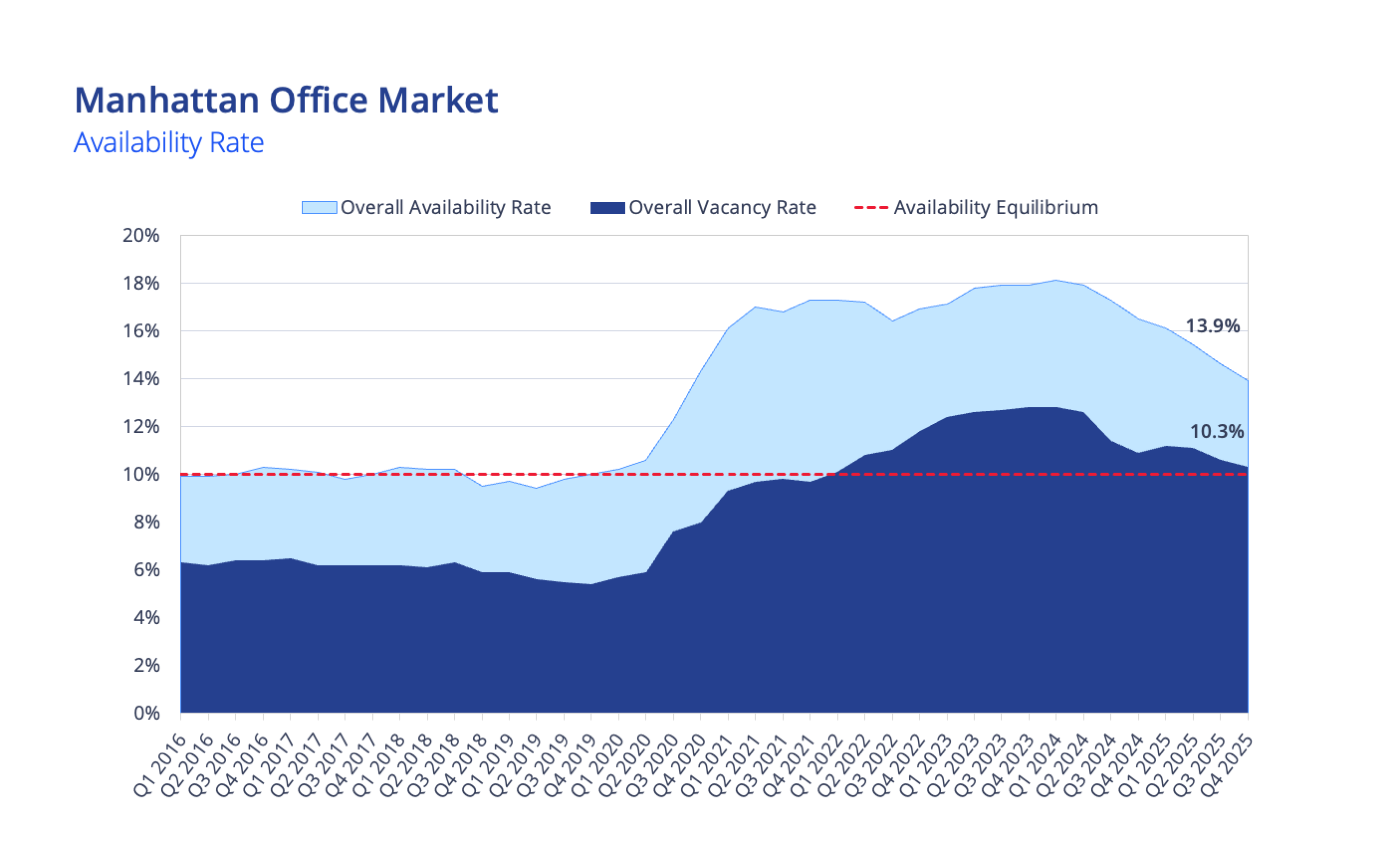
The Manhattan office market experienced a watershed year in its post-pandemic recovery. On the demand side, leasing volume in 2025 was the highest in six years. On the supply side, availability was at its lowest since November 2020, while sublet supply was the tightest since late 2019.

But the most compelling metric of Manhattan’s recovery was the record-level 15.56M SF of positive absorption for the year, a headline-grabbing total that far surpassed the previous high watermark of 8.44M SF more than a decade ago.[1] Given this notable level of absorption, a deeper analysis is warranted to understand what factors drove the surge and whether it could repeat in 2026.
Key Drivers of Absorption
Absorption has long been a critical metric for measuring the health of the office market, yet it is often overlooked or even at times misunderstood. To explain what drove Manhattan’s record-level absorption in 2025, it is important to first re-establish its definition. At its simplest, absorption is the result of the interplay between supply and demand. Positive absorption occurs when more space is removed from the available supply — through leasing or other factors that withdraw space from the market — than is added. Negative absorption occurs when the opposite happens.
Because absorption reflects the net result of supply and demand dynamics, strong leasing volume does not always translate into positive absorption. There have been periods of negative absorption despite strong leasing volume, just as Manhattan’s history includes instances of positive absorption during periods of relatively muted demand.

In 2025, a confluence of factors drove more than 15.00M SF of positive absorption in Manhattan. First, following a healthy level of demand in 2024 — at 33.34M SF and comparable to the typical yearly activity since 2000 — the leasing velocity was supercharged in 2025 at 41.92M SF.[2] The uptick was fueled by flight-to-quality opportunities, return-to-office mandates, the re-emergence of Manhattan’s tech sector, and strong demand from financial and professional services tenants, among other factors. Mega-leases amplified this activity, including NYU at 770 Broadway (1.08M SF), Jane Street Group at 250 Vesey Street (984,000 sq. ft.), and Deloitte at 70 Hudson Yards (807,000 sq. ft.). As a result, 2025 marked Manhattan’s highest yearly leasing total since 2019 (42.97M SF) and was only 2.4% below the pre-pandemic total in 2019.
Second, the strong absorption in 2025 was buoyed by Manhattan’s rapidly tightening availability. Although the available supply grew by 36.7% since March 2020, the December 2025 total of 73.61M SF was substantially lower than the post-pandemic peak of 98.05M SF in February 2024 and represented Manhattan’s tightest availability since November 2020. An uptick in tenant activity and an increased demand for high-quality, built and furnished sublet space contributed to the dwindling available supply, along with blocks of existing sublets withdrawn due to reoccupancy by sublessors. In total, there was a 37.0% reduction in sublet inventory over the last 12 months, leaving 11.41M SF, Manhattan’s lowest level since October 2019.
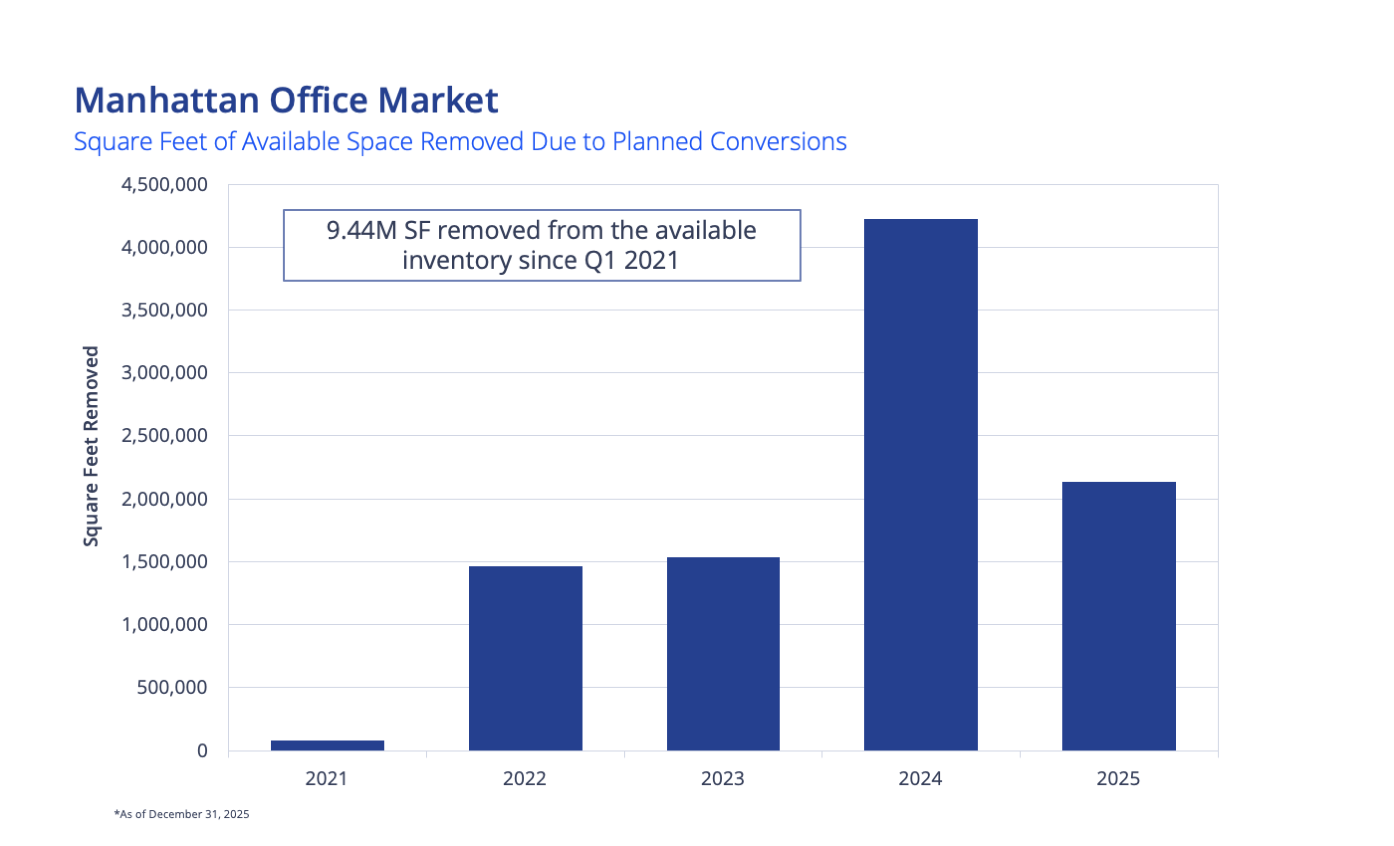
One final key driver that impacted the dynamic between supply and demand was the volume of space removed from the market for conversion to residential, hotel, storage, or other non-office use. Planned conversions — including at 5 Times Square, 135 East 57th Street, 845 Third Avenue, and 101 Greenwich Street — totaled 2.14M SF across 16 office buildings that were removed from the market in 2025. Not only did these conversions remove supply from the market, but they also triggered a secondary wave of absorption as office tenants in these buildings leased space and relocated within the market.
Looking Ahead to 2026
Manhattan’s record-level 15.56M SF of positive absorption in 2025 was a clear indicator of the post-pandemic recovery in one of the world’s most consequential office markets. The key question for 2026 is whether the market will see another record level of positive absorption. The short answer is, it is possible, although not likely. The sheer fact that the net absorption in 2025 was nearly double the prior high of 8.44M SF in 2014 means that repeating what was accomplished in 2025 will be difficult, at best. At the peak of Manhattan’s post-pandemic supply, the availability — at 98.05M SF — had nearly doubled from the March 2020 level of 53.85M SF, and the 18.2% availability rate in February 2024 was a record-high that was significantly above the peak availability rate during both the Great Recession and 2001 Recession.[3] Therefore, the post-pandemic Manhattan office market had an exceptional level of excess supply, creating the conditions for strong positive absorption once the market improved.
As 2026 began, Manhattan had less surplus availability. With year-end supply at 73.61M SF, roughly half of the post-pandemic glut had been absorbed. About 20.00M SF of redundant availability remained, but there was less “low-hanging fruit”. The sublet inventory had already returned to pre-pandemic levels, and the prime areas of the market – such as Midtown’s Park Avenue, Madison Avenue, and Downtown’s post-2000 product – were also below the March 2020 benchmark. However, Manhattan’s Class B and Class C availability were still operating with a combined 12.74M SF supply glut, providing continued opportunities for value-seeking tenants or potential future conversions. This is especially relevant in light of the recently approved Midtown South Mixed-Use Plan, which encourages further residential conversions in pockets of Midtown South.[4] Nevertheless, even if 2026 does not match the 2025 net positive absorption total of 15.56M SF, any level of positive absorption for the year, combined with healthy tenant demand and tightening availability, would affirm Manhattan’s continued recovery trajectory.
Sources
[1] Note: Colliers’ Manhattan absorption data has been tracked since 2008.
[2] Colliers’ leasing activity data includes all lease types greater than 5,000 square feet, including new leases, renewals, expansions, and occasional sale-leasebacks with a minimum term of 12 months.
[3] Colliers’ availability rate includes only office spaces scheduled for tenant build-out within 12 months.
[4] Source: https://www.midtownsouthplan.nyc/

 Rachael Rothman