 Marianne Skorupski
 Haley Boatright
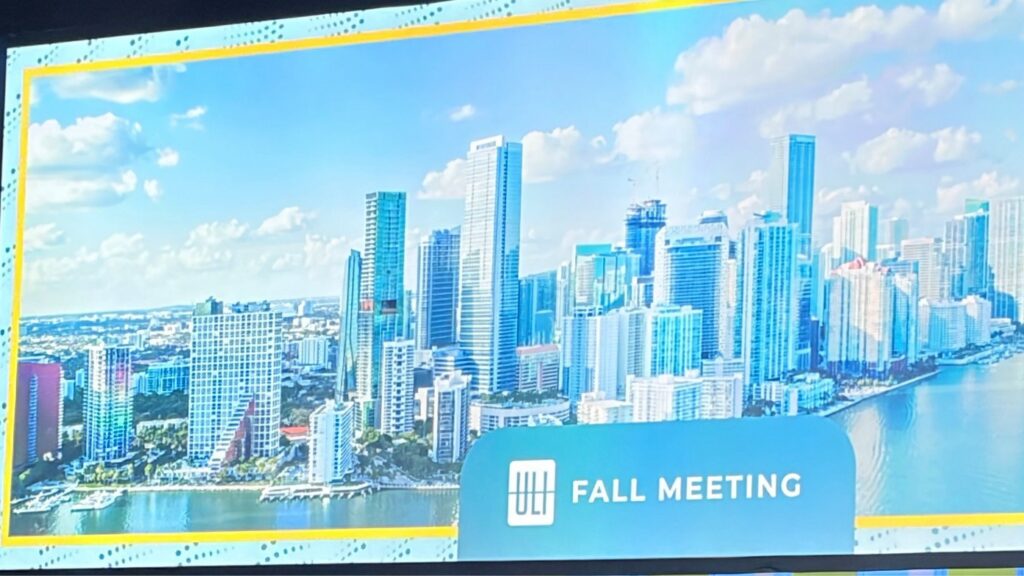
The 2026 ULI Fall Meeting in Miami Beach, held October 26-28, brought together more than 5,000 real estate, development, planning, and investment professionals for three days of keynotes, panels, and project tours. Topics spanned capital markets, housing, office, retail, and global investment, and several themes surfaced repeatedly: capital is available but selective and relationship-driven, public-private partnerships increasingly determine whether deals work, and AI and shifting demographics are changing how and where we build.
Here are eight key takeaways:
1. AI is reshaping the industry, and the time to engage is now
AI offers real opportunity for real estate, and real risk if adoption outpaces understanding. AI is already driving demand for data centers, digital infrastructure, and innovation-oriented markets while creating productivity gains across industries. Cities with strong research institutions, talent pipelines, and technology ecosystems are expected to benefit most. Today’s tools are built to agree with the user, so human oversight and an evidence-based approach matter more than ever. Owners and occupiers are already bringing work such as renderings in-house at lower cost and with faster turnaround, freeing teams for higher-level analysis and decision-making. Real estate firms should begin testing these tools now rather than waiting.
2. Capital is available, but it is selective and favors relationships
Capital is available, but it goes where investors are comfortable. That puts a premium on relationships and sponsor quality. Investors weigh the sponsor and their view of the market alongside each part of the capital stack, and the deal itself still must make sense. Developers raising capital are best served by a clear “why now,” a strong case for the project’s value to the public sector, and familiarity with local grants, tax incentives, and other programs. Staying informed on the local market and showing up consistently help build the relationships capital follows. Trying to time the market carries its own risk: if a deal works today, conditions are unlikely to look materially different a year from now.
The same selectivity shows up globally, and the rules of past cycles no longer apply as they once did. Europe’s return to capital has been slow, with limited repricing expected. Cap rates in the Americas have adjusted, and Asia-Pacific rates have risen roughly 100 basis points, with residential emerging as a core investment. Nearshoring is a major driver in Mexico, and regionalization appears to be a long-term trend. Geopolitical risk is present everywhere, and the industry is adapting.
By asset type, industrial was the most-cited opportunity across regions. Office remains challenged, particularly poorly located buildings that must become destinations to draw people. Conversions and repurposing are popular, especially in Europe, but difficult to execute. In the Americas, investors are selective by asset type and location, recycling portfolios within markets, and questioning where population will shift as density and congestion build in the Sunbelt. The market remains driven largely by owners who must trade.
3. Public-private partnerships are helping close the gap
Projects that meet a public need and lower costs are the ones most likely to move forward. Tools such as tax increment financing can reposition properties constrained by existing tax burdens and, when combined with bonds and equity, can close funding gaps. Public-private partnerships should play a larger role over the next year as federal tools tighten, and state and local governments get more creative.
Housing is the clearest example. The private sector alone is unlikely to solve affordability and generally needs public support for projects to pencil. Related issues, such as how utility costs are split between owners and renters in multifamily, continue to evolve and vary by market.
4. Occupiers are redefining what makes a great office
Vibrancy has become a measure of office success, reflecting both how space is used and how it feels. Occupiers want flexibility, including break options, fewer use restrictions, and the ability to expand or contract within the same building. A landlord’s approach to build-out flexibility signals how the relationship will perform over a long lease, and occupiers increasingly see landlords as long-term partners rather than one-time counterparties.
On amenities, simple and functional features win. Quality coffee, inviting connecting stairs, and phone rooms for private calls were seen as underrated, while collaboration space, game rooms, unconventional furniture, and costly, underused fitness centers were seen as overrated. The office is becoming a place to present, debate, and connect with other teams rather than complete individual tasks. Landlords should regularly walk their assets, understand tenant pain points, and maintain open dialogue with tenants and operators.
5. “Wall Street South” momentum is real, but supply and infrastructure are constraints
South Florida has moved well beyond its earlier role as a gateway to Latin America and now draws the label “Wall Street South.” The main constraint is a limited supply of high-quality office space. Demand sometimes exceeds supply, which calls for short-term stopgap solutions. Citadel’s tower, the Santander Tower, and strong preleasing at The Well in Miami Beach illustrate the depth of demand for new supply in well-located, highly desirable submarkets.
Carnegie Mellon University’s planned South Florida campus, supported by a major gift from Citadel’s Ken Griffin, is expected to attract companies to the market, much as its Pittsburgh campus did. That pull is reinforced by firms already in the market, which report that talent elsewhere is eager to relocate and that proximity to business partners remains a priority. Mobility, education, and affordability are the other constraints, and infrastructure and livability will shape how long this momentum lasts.
6. Retail rewards curation and sense of place, but underwriting discipline matters
Retail is increasingly defined by curation, active management, and a sense of place. Managed merchandising models let operators replace an underperforming brand quickly, helping landlords avoid dark stores and keeping the shopper experience consistent. Owners are shortening lease terms to as little as three years and welcoming pop-ups so tenants can prove their concepts and keep centers fresh, while anchors continue to sign longer terms. Meanwhile, luxury brands are seeking more space and consolidation.
Experiential activation, such as community partnerships, in-store events, and block parties on high streets, helps drive traffic. Neighborhood districts with heavy curation and tenants treated as partners, including local food and art operators, show how this approach supports leasing momentum.
High construction costs are pricing out small, local operators, leaving a gap that needs a solution, even though credit tenants help ensure rent is paid. National brands, by contrast, need a location with strategic meaning and a reason to succeed there. Entertainment retail remains viable, but landlords are wary of centers that rely on it too heavily, and high failure rates make it difficult to underwrite.
Operator quality and post-construction discipline also matter, and soft goods can still support occupancy costs of roughly 10%. On the financing side, Weighted Average Lease Term (WALT) affects loan terms, and the focus is shifting toward fundamentals, conviction in the vision, and having the right partners to take on risk. Retailers, for their part, are asking more of landlords.
7. Demographics and housing call for planning on a 40-year horizon
Younger generations often don’t feel the progress previous generations did, and some don’t expect to be better off than their parents. That frustration is global and is already shaping housing demand and affordability, which makes the case for planning further out than the industry does today. Approaches such as gentle density show why: changes made compound over time, so even modest decisions today can deliver outsized benefits over a 40-year horizon.
Sense of place matters here too. People want community, including schools and parks, and building seniors housing where boomers already live can ease transitions, free up existing housing, and keep residents in their communities. The demographic data adds context: household formation is down, immigration is sharply lower, and population growth is negative due to fewer births, less immigration, and an aging population.
8. Location quality and market selection matter more than broad regional strategies
Performance differences between individual cities and assets are becoming more significant than differences between countries or regions. Investors are moving beyond broad geographic allocations and placing greater emphasis on selecting cities that demonstrate resilience across economic growth, talent, infrastructure, governance, technology adoption, and environmental risk.
Population growth, workforce mobility, aging demographics, and corporate migration were repeatedly identified as the most important long-term drivers of real estate demand. Sun Belt markets continue to benefit from in-migration, while aging populations are supporting demand for senior housing, healthcare-related real estate, and lifestyle-oriented communities. Investors increasingly need to evaluate demographic trends alongside traditional economic indicators when making location decisions. Commercial real estate is entering a period where fundamentals matter more than financial engineering. Investors are increasingly focused on operational execution, market selection, demographic trends, technology adoption, and resilience. The most successful markets will likely attract talent, foster innovation, invest in infrastructure, and adapt to economic, geopolitical, and climate-related challenges.

 Rachael Rothman