

 Mike Pham
 Derek Daniels
 Bryan Courson
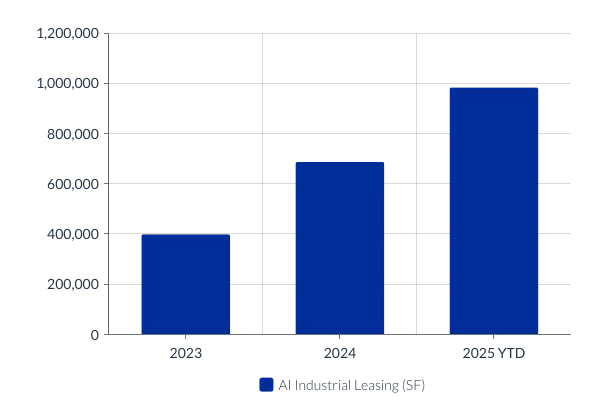
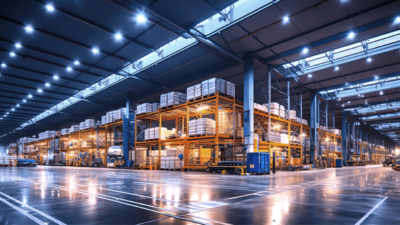
The Silicon Valley industrial market has boomed in 2025, driven by surging demand from artificial intelligence (AI) and AI-infrastructure firms. These companies have signed new leases totaling 982,000 square feet of industrial and warehouse space in 2025 as of July 2025 — an increase of 101.6% over the same period in 2024 and already surpassing the prior year total in just two quarters. Though narratives on the impact of AI tend to focus on the office sector, where collaborative, amenity rich office spaces are needed to attract engineering talent, AI’s impact is potentially even more significant on the industrial landscape due to the infrastructure needed to support AI operations.
Industrial Leasing Outpaces Office, R&D in 2025
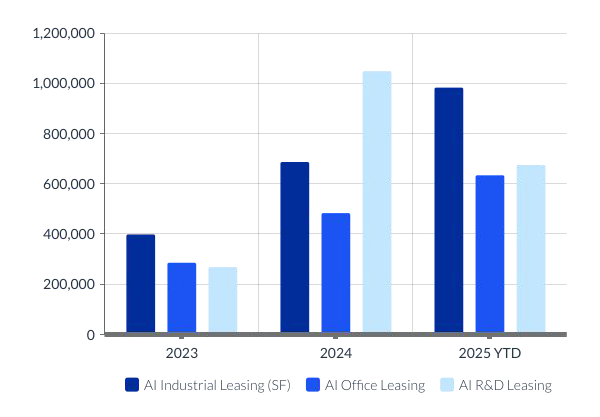
Industrial demand has surpassed office and R&D leasing in 2025 due to heightened demand for heavy power facilities with ample storage capacity to support hardware manufacturing, efficient cooling systems, and AI-infrastructure deployment. The public release of ChatGPT in 2022 has fueled an explosion of AI-enabled new technologies, ranging from autonomous vehicles to the life science industry, where companies have sought to use AI to refine clinical trials and gene sequencing. Regardless of how it’s used, however, AI computing requires a heavy power draw, and these power requirements are often only found in buildings zoned for industrial use. If Silicon Valley is the backbone of AI development, then the industrial sector is the backbone of Silicon Valley.
AI Occupiers Prefer High-End Space
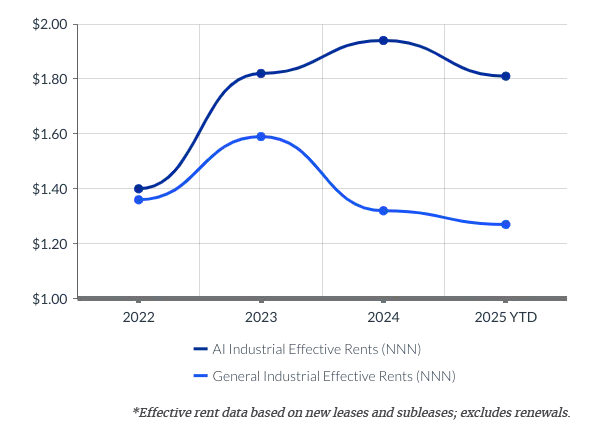
As the AI industry matures, demand has risen for specialized industrial properties with high-end buildouts: this trend is evidenced by effective rents on new transactions*, where the gap between high-tech manufacturing facilities and older, general-purpose industrial buildings has widened as AI companies increasingly opt for premium space. The difference between the two kinds of space is significant, with advanced manufacturing carrying a 42.5% premium over general industrial space based on new industrial leases signed in 2025, creating a clear bifurcation of the industrial market. With Silicon Valley overall vacancy at just 4.9%, the scarcity of top-tier space is expected to continue to drive this premium even higher in 2025.
 Craig Hurvitz

 Shawn Machado