


- The 30-year Treasury yield eclipsed 5.3% last week and is now hovering around 5.2%, its highest level since 2007, reflecting concerns about inflation, government borrowing, and rising debt supply. The 10-year Treasury is hovering near 4.75%, up more than 35 basis points over the past 30 days.
- Treasury demand remains intact, but the buyer base is shifting from foreign governments and central banks toward investment funds and other price-sensitive investors.
- Federal debt has surpassed $40 trillion, raising concerns that growing Treasury issuance will keep long-term borrowing costs elevated across the economy.
- Record corporate bond issuance tied to AI investment, combined with Treasury Secretary Scott Bessent’s recent market intervention, highlights growing competition for capital and the challenges of containing long-term rates through liquidity measures alone.
Long-term Treasury yields have moved sharply higher in recent weeks as investors weigh persistent inflation pressures and expanding federal deficits. While Treasury demand remains solid, investors are seeking higher compensation to absorb record issuance levels amid declining participation from traditional buyers such as China, Japan, and the Federal Reserve. In turn, funds and leveraged investors are taking on a larger share of Treasury purchases, making demand more sensitive to market conditions and volatility. Increased competition from AI-related corporate borrowing is adding further pressure. The result is an elevated cost-of-capital environment that continues to influence borrowing, valuations, and investment activity across markets.
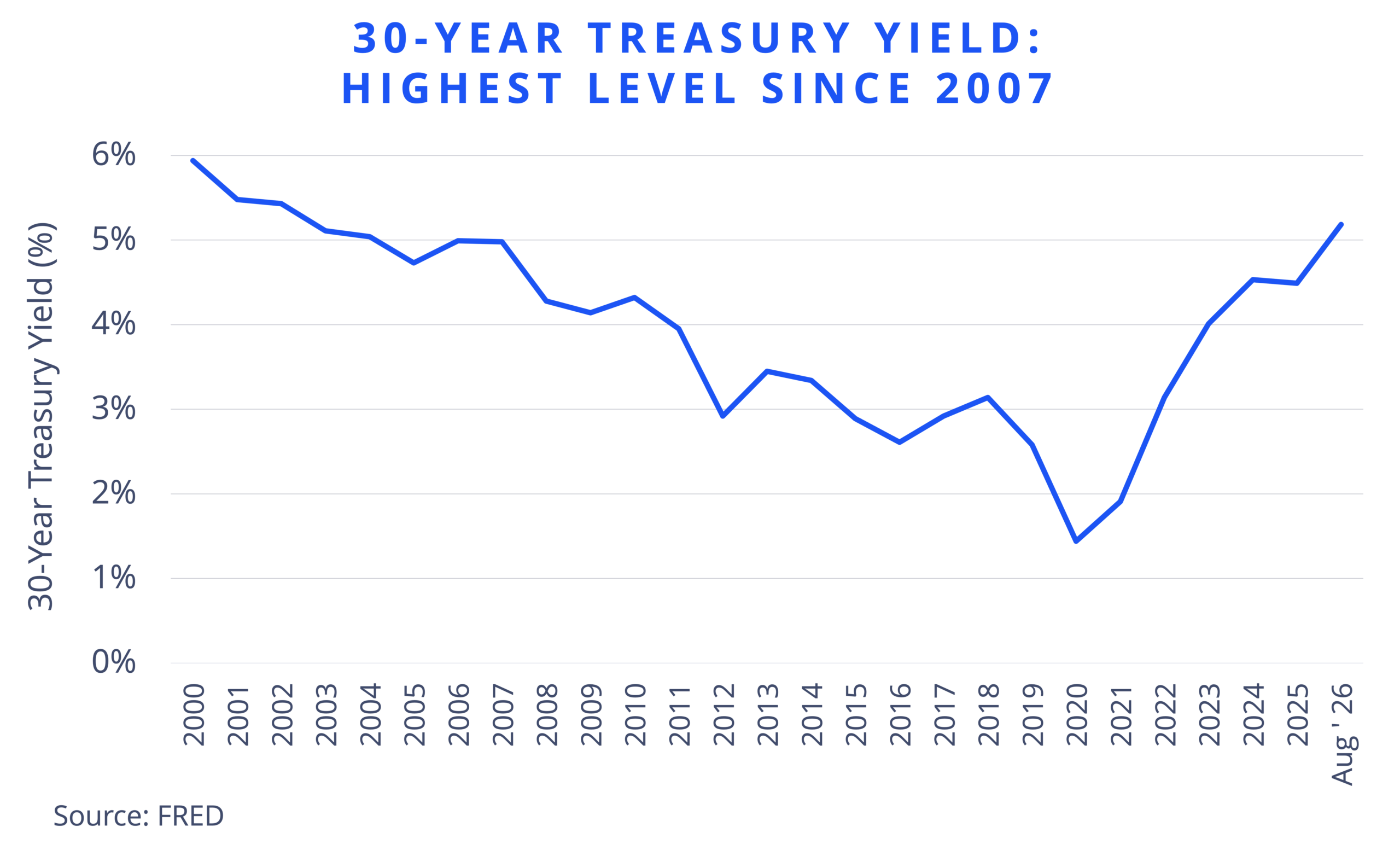
The fiscal backdrop is adding to the challenge. Federal debt recently exceeded $40 trillion, while annual interest costs continue to climb. Higher Treasury yields are increasingly flowing through to mortgages, corporate borrowing, and commercial real estate financing, driving up borrowing costs throughout the economy.
Another source of strain is a surge in corporate borrowing tied to AI infrastructure and development. Oxford Economics estimates investment-grade corporate issuance has reached approximately $1.5 trillion this year, creating direct competition with Treasury issuance for investor capital. Last week, Scott Bessent attempted to ease pressure on longer-term rates by expanding Treasury buybacks, a move that initially lowered yields. However, markets quickly reversed course as investors refocused on broader structural concerns around debt supply, deficits, and inflation risk.
For commercial real estate, the implications remain significant. Elevated Treasury yields continue to pressure debt costs, limit cap-rate compression, and raise return hurdles for acquisitions and refinancing activity. While capital availability has improved, the pace of recovery will likely remain driven by property fundamentals and disciplined underwriting rather than lower interest rates alone.
 Steig Seaward
Heavy government and corporate issuance is intensifying competition for investor capital.