

 Anjee Solanki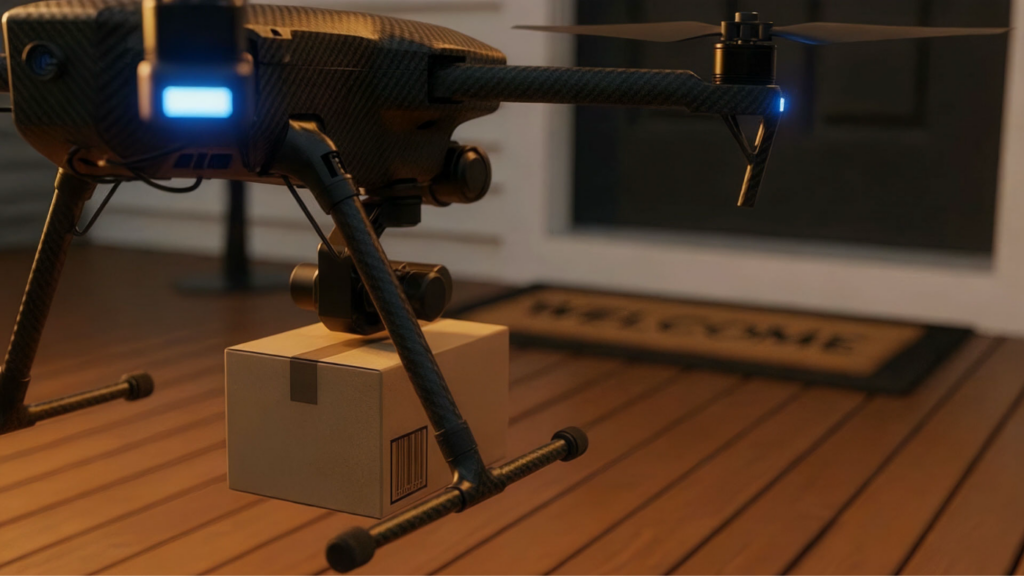
America’s retail delivery networks are welcoming a new fleet of autonomous drones. Imagine cooking dinner and realizing you’re missing a key ingredient. A drone-enabled retailer could deliver it to your doorstep in just fifteen minutes. It may sound like a scenario from a science-fiction story, but it’s quickly becoming a real-world retail solution.
Testing and implementation are underway in the United States, although the market still lags behind China’s more advanced drone-delivery sector. Retailers Walmart and Amazon, drone operators Wing and Zipline, and delivery platform DoorDash, which has incorporated drones into its multimodal network, are leading the charge. Consumer reception is more complicated than the convenience case suggests, and in some markets, it is already appearing on city council agendas. Retailers are moving ahead regardless because today’s technology extends their reach and enables them to serve more customers.
Where drone delivery makes the most sense
Quick-service restaurants, grocery stores, and pharmacies are among the most viable sectors for drone delivery because convenience lies at the heart of their business models. Rather than relying solely on strategically located stores that consumers must visit, retailers are reversing the model by bringing convenience — and inventory — directly to customers. In recent years, Chipotle, Chick-fil-A, and Wendy’s have tested drone delivery in select markets.
A unified national standard for commercial drone operations is close but not yet in place. The FAA’s proposed Part 108 rule, which would replace many case-by-case waivers with a scalable framework for routine flights, entered final White House review in July 2026. Publication is expected in late 2026 or early 2027, followed by a transition period — potentially clearing a path for retailers to scale services such as drone-delivered ice cream.
From omnichannel experiment to fulfillment strategy
Drone delivery may seem like another tactic to attract consumers, but its strategic value lies in strengthening existing omnichannel networks. Retailers have spent years synchronizing customer-facing platforms with fulfillment operations. Now, amid consistently growing demand for speed, convenience, and affordability, they are testing whether drones can lower last-mile costs, improve the customer experience, and extend delivery coverage.
Beyond expanding convenience and consumer reach, automated delivery offers a second operational advantage: labor leverage. Despite a single remote pilot overseeing as many as 32 aircraft, the per-package economics, however, don’t yet favor drones. Current estimates put drone delivery above ground delivery, not below it: roughly $13.50 per drone delivery in 2025 against about $2 by traditional vehicle, with Amazon’s own 2025 projection as high as $63 versus $6 to $10 for ground, and DroneUp charging around $30 today against a target of under $7. Which raises the more useful question: why build now, at a premium? The answer is in the word network. Per-delivery cost falls as node density rises, so the more launch sites an operator has in a metro, the cheaper each delivery becomes. Drone economics improve less through better aircraft than through denser real estate. That makes site acquisition the gating factor on the entire cost curve, and it is happening now, one submarket at a time.
Growth begins in suburban drone zones
Early commercial deployments favor dense suburban neighborhoods, where residential and commercial addresses fall within a short flight radius, airspace obstructions are limited, and there is no downtown skyline to navigate. Amazon’s Chicago-area service is designed to reach roughly 7.5 miles from 20,000-square-foot launchpads being built in the parking lots of its Markham and Matteson fulfillment centers.
DoorDash and Wing’s Atlanta service launched at Tanger Outlets Locust Grove, about 35 miles southeast of downtown, with a delivery radius of approximately four miles. Wing also opened Charlotte-area nests at Sun Valley Commons and a Lowe’s off Matthews Township Parkway. Meanwhile, Zipline’s Dallas–Fort Worth network spans more than 25 public locations.
These deployments show how drone infrastructure can be placed on surplus parking or back-of-lot space at existing properties rather than built from the ground up. For owners, the opportunity poses two questions: whether drone service is active or merely planned in its market, and whether a property can accommodate the required infrastructure.
Service is live or rolling out across Dallas–Fort Worth, Greater Houston, metro Atlanta, Charlotte, Tampa, Orlando, Miami, Los Angeles, Detroit, St. Louis, and Cincinnati. In June, Walmart and Wing announced seven additional markets: Memphis, New Orleans, Philadelphia, Phoenix, San Diego, Salt Lake City, and the San Francisco Bay Area, where service is targeted for 2027. Active markets provide evidence of current property demand; announced markets indicate potential leasing opportunities.
Adoption is a local negotiation
Growth is outpacing community buy-in. In Ferndale, Michigan, officials are reviewing resident complaints about noise, altitude, and flight frequency with legal and ordinance advisers. Meanwhile, Dallas homeowners have cited privacy, wildlife disruption, and the risk of a malfunction over an occupied yard. Operators contest the scale: Amazon says noise accounts for fewer than 1% of Prime Air customer service inquiries this year and is audible for roughly 30 seconds per overflight, while Walmart notes that Zipline operates more quietly than the average delivery truck. The FAA controls aviation safety and airspace, limiting municipal authority over flights, although cities retain some leverage through zoning, launch-site approvals, privacy, and nuisance rules. Pressure, therefore, falls largely on operators, retailers, and launch-site owners.
The next frontier lies beyond the suburbs
Populated suburbs offer the clearest conditions for scaling. Still, retailers are also exploring rural, exurban, and retail-desert markets, where flight paths cross fewer neighbors, conventional delivery can be expensive, and access to retail is limited. Roughly 70% of U.S. consumers live outside dense urban centers, including about 49% in suburban or exurban communities and 20% in rural areas.
This opportunity may grow as migration pushes more households toward secondary and exurban markets. Recent Placer.ai data shows domestic migration increasingly concentrating in smaller metros and intra-state corridors, with many of the fastest-growing markets combining relative affordability, suburban density, and proximity to larger economic hubs. As populations spread farther from traditional retail nodes, drone delivery could help retailers extend their reach without requiring the same density of physical stores.
If drones can lower the cost of reaching those customers, they could expand retailers’ delivery networks and make a broader range of suburban and select rural properties viable as fulfillment hubs.

 Nicole Larson