

 Nicole Larson
 Marianne Skorupski
When the 2026 FIFA World Cup came to the United States, expectations were high for retailers, restaurants, and commercial real estate owners across host markets. Millions of fans traveled to matches, fan festivals, and watch parties, creating a substantial economic impact and fueling expectations of broad-based gains for local businesses. Yet the data tells a more nuanced story.
In a new collaborative report with Placer.ai, Colliers analyzed visitation patterns across World Cup host cities and found that success wasn’t determined solely by location in a host market. Instead, the biggest gains were concentrated among businesses that aligned with specific fan behaviors, locations, and event experiences.
Mega-Events Don’t Automatically Lift an Entire Market
One of the report’s most surprising findings was that host markets had only a slight overall advantage in retail visitation compared with non-host markets during the tournament. The World Cup generated significant economic activity, but that demand was not evenly distributed across metropolitan areas. Instead, visitors gravitated toward locations and concepts directly connected to the event experience.
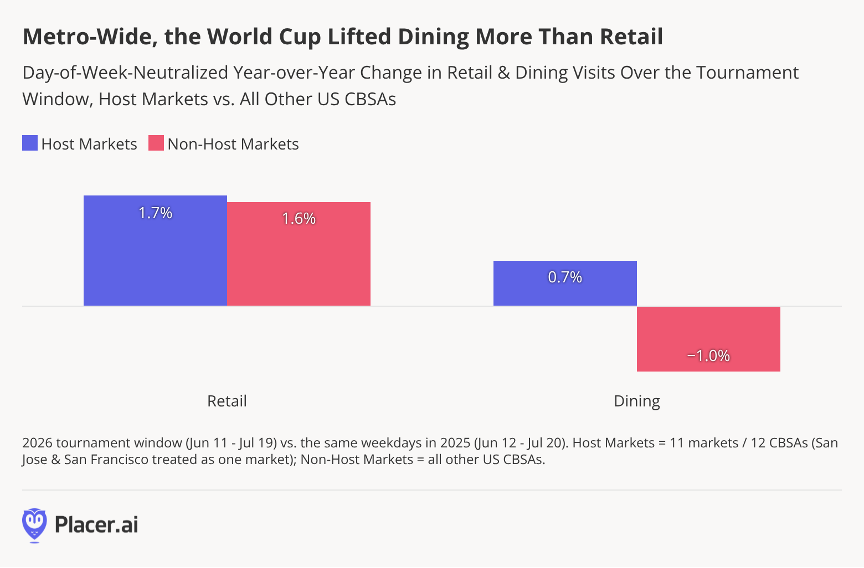
For retailers, restaurants, and property owners, that distinction matters. Simply operating within a host city was not enough to guarantee increased traffic.
The Biggest Winners Were Built Around the Fan Journey
Bars and pubs emerged as among the strongest performers on match days, averaging a 9% increase in visits across host markets, while sporting goods retailers consistently outperformed broader retail categories. The common denominator was relevance: these businesses provided products, services, and experiences closely tied to how consumers participated in the tournament.
Meanwhile, many traditional retail categories experienced far more mixed results, reinforcing the importance of creating a clear connection between the consumer and the event.
The Real Opportunity Was Hyperlocal
Perhaps the strongest lesson for commercial real estate came from what happened around stadiums. The data showed that retail visits increased by 22.0% and dining visits surged by more than 50.0% within 1-mile of World Cup venues. Those gains declined rapidly as the distance from the stadium increased.

The findings underscore a reality that extends well beyond the World Cup: neighborhood-level analysis often matters more than market-level assumptions. Assets positioned along the consumer journey, whether near venues, activation sites, entertainment districts, or key pedestrian corridors, were often better positioned to capture spending than properties simply located within the broader host market.
Looking Ahead
As cities continue to compete for major sporting events, concerts, and large-scale entertainment experiences, the lessons from the World Cup offer a valuable roadmap. The greatest opportunities may not come from the event itself, but from understanding how consumers move through a market and designing places, properties, and experiences that become part of that journey.
Read the full Placer.ai and Colliers report, “7 World Cup Lessons for Retail, Dining & Real Estate,” to explore all seven lessons and see how major events are reshaping opportunities across retail, dining, and commercial real estate.

 Anjee Solanki
 Haley Boatright