


- North Carolina and Texas continue to lead in growth and business formation, reinforcing capital inflows, though fiscal exposure and macroeconomic sensitivity require more disciplined pricing.
- Gateway markets such as California and New York still anchor global capital, maintaining deep liquidity and institutional relevance despite affordability, labor, and cyclicality concerns.
- High-trade states offer growth and industrial demand but add volatility tied to tariffs and geopolitical shifts.
- Housing is increasingly a capital constraint as affordability and supply dynamics emerge as key drivers of labor availability, absorption, and long-term rent growth.
State-level economic resilience is increasingly shaping corporate location decisions, the direction of capital flows, and long-term CRE performance. CNBC’s latest rankings highlight where growth, liquidity, and housing dynamics are most likely to support sustained institutional demand and where structural risks could pressure returns.
North Carolina and Texas illustrate that divide as they continue to attract an outsized share of capital and support corporate expansion, reinforcing Sun Belt momentum. However, both face emerging pressures: North Carolina from its reliance on federal funding and Texas from housing softness and trade exposure. These factors introduce greater variability into cash flow expectations and underwriting assumptions.
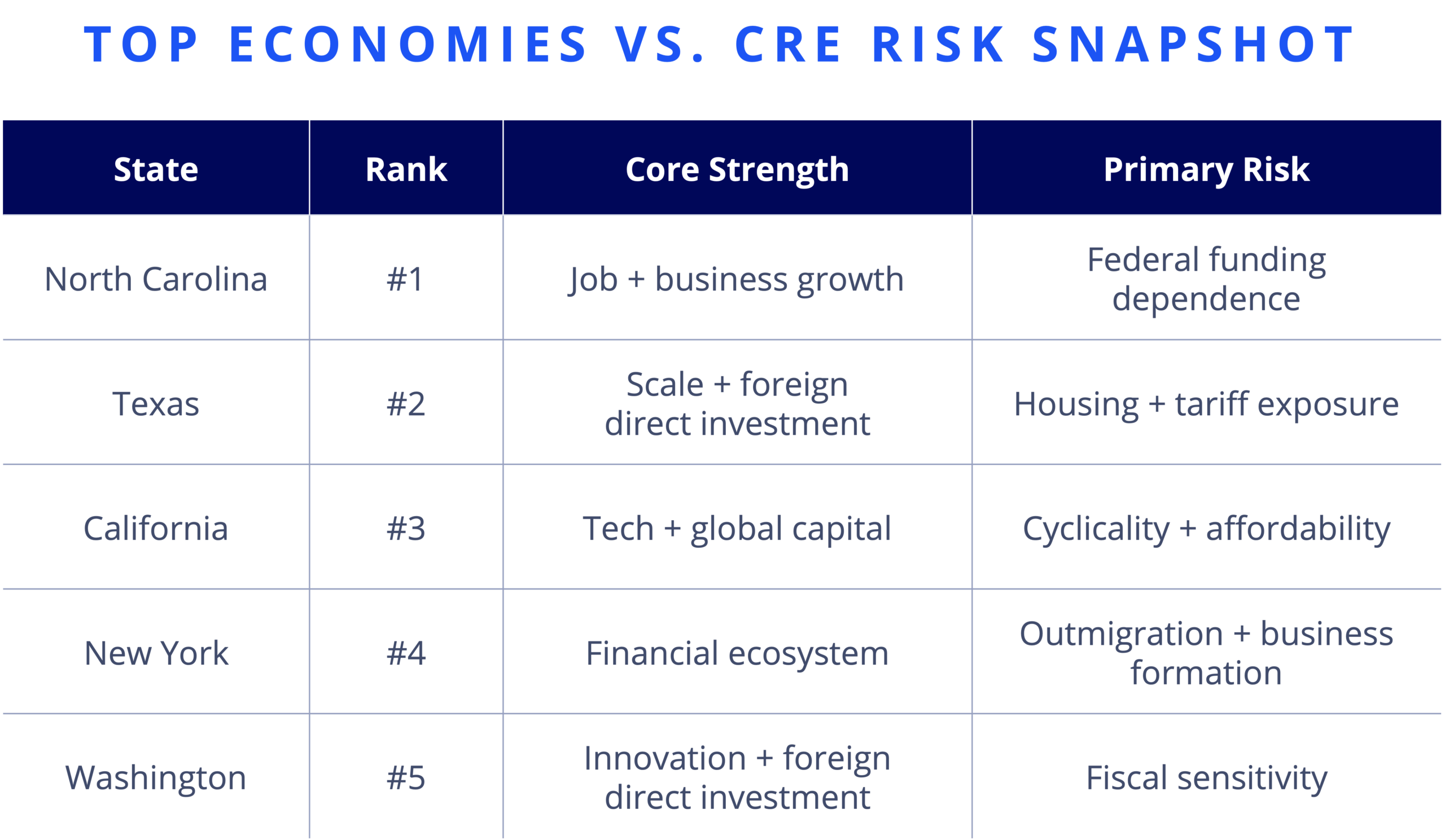
California and New York remain core institutional markets with unmatched depth of capital and global investor participation. However, rising affordability constraints, labor shifts, and fiscal variability are driving a more selective, basis-sensitive approach, with investors prioritizing asset quality, location, and sector-specific demand drivers.
Secondary markets, and parts of the Midwest and Southeast, are gaining traction as lower-cost, business-friendly alternatives. While they lack the liquidity depth of gateway markets, improving fundamentals and relative affordability are supporting incremental capital rotation and diversification strategies.
 Steig Seaward
Texas and North Carolina continue to attract capital and support corporate expansion, though fiscal, housing, and trade pressures call for more disciplined underwriting.
States at the bottom of the rankings face persistent structural headwinds, including slower job and population growth, weak business formation, and reliance on narrow industries or federal support. These factors limit diversification and resilience. For investors, they translate into reduced capital inflows, thinner liquidity, and greater risk to exit pricing. Together, they reinforce the widening gap between high-growth and structurally constrained markets.

 Rachael Rothman