


Pricing trends and transaction activity continue to shape how the market evolves. At Colliers, we analyze these signals to interpret shifts across U.S. commercial real estate. Here’s what the latest MSCI data reveals.
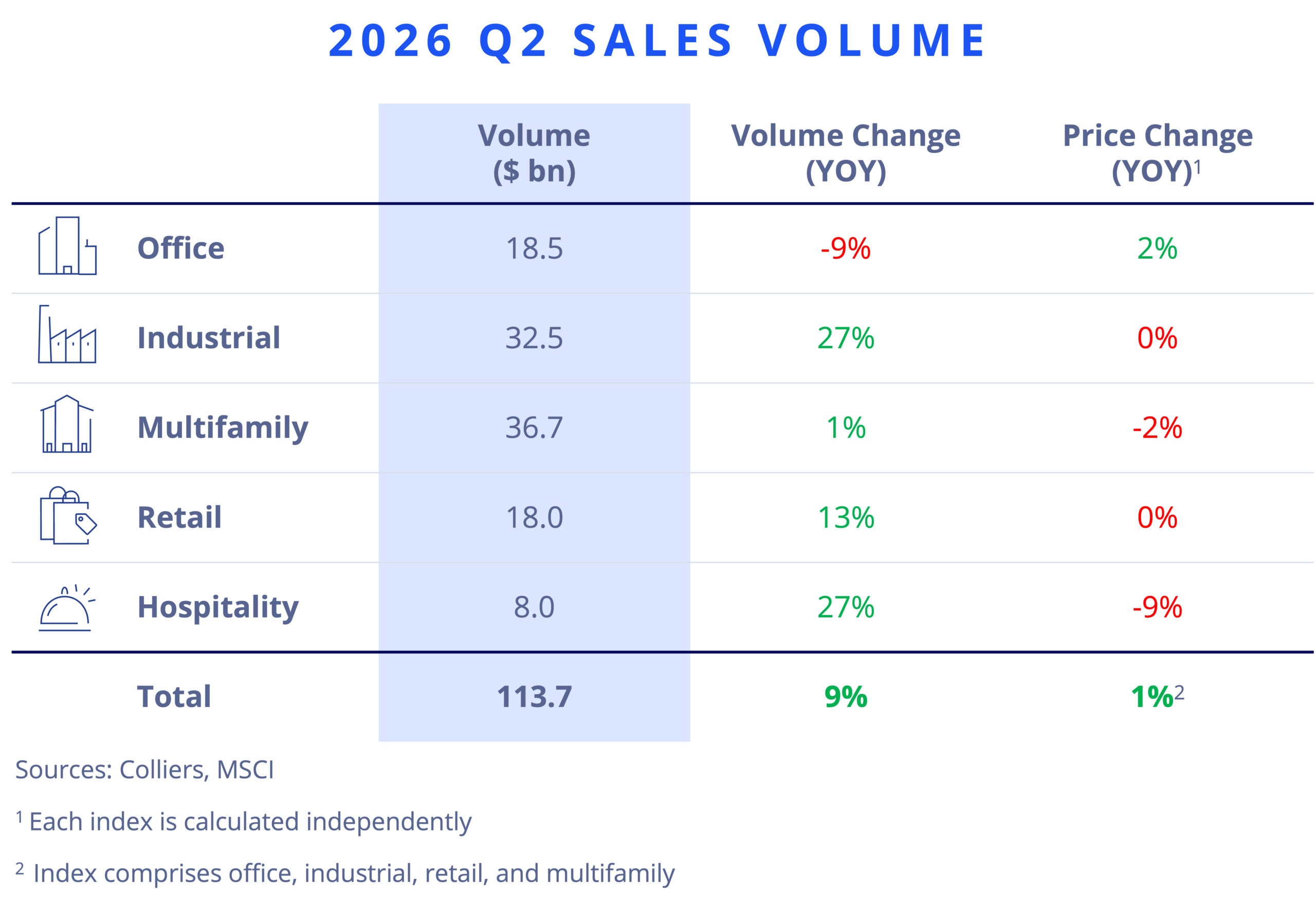
- Investment volume reached $113.7 billion, up 9% year over year, marking the third consecutive quarter of near- or double-digit gains as the recovery from the 2023-2024 lows continues.
- Entity-level transactions reemerged, with three notable take-private deals—Veris Residential, ECHO Realty, and Peakstone Realty Trust—lifting headline figures.
- Industrial and hospitality led volume growth at 27% each, while multifamily remained essentially flat as garden apartment weakness offset mid- and high-rise gains.
- Pricing remained mixed, with the all-property index up just 0.9% as cap rates drifted higher and sector-level divergence persisted.
Office
Office investment activity declined modestly in Q2, with $18.5 billion in transactions, down 9% year over year, though much of the drop traced to a particularly weak May rather than a new downtrend. For the first half of 2026, volume remained up 14% from last year’s pace. Suburban offices outperformed CBD offices, with volume down only 5% compared to a 17% decline for CBD properties. Pricing showed tentative signs of stabilization, with the RCA CPPI for offices up 2.2% year over year, marking four consecutive quarters of gains for CBD and five for suburban assets.
Industrial
Industrial remained one of the most liquid sectors, recording $32.5 billion in Q2 volume, up 27% year over year. Individual asset sales posted double-digit growth for the fourth consecutive quarter. Portfolio and entity activity rose 33%, including the privatization of Plymouth Industrial REIT earlier in the year. Despite healthy deal flow, pricing turned negative year over year, with the RCA CPPI for industrial down 0.4%, reversing the sector’s recent position as the pricing leader.
Multifamily
Multifamily investment totaled $36.7 billion in Q2, essentially flat year over year, but headline stability masked underlying weakness. Individual asset sales fell 7%, the first decline after five consecutive quarters of growth, while portfolio sales dropped 16%. Garden apartments drove much of the weakness, with volume down 21%. One large transaction, the $3.5 billion take-private of Veris Residential, propped up the quarter’s figures. Pricing softened further, with the RCA CPPI for apartments down 1.7% from a year earlier, extending a two-year run of negative readings.
 Steig Seaward
Investment momentum strengthened, but gains remained uneven across sectors and asset types.
Retail
Retail transaction volume reached $18 billion, up 13% year over year, though a single transaction, the sale of ECHO Realty to a TPG-led joint venture, accounted for most of the gain. Excluding that deal, quarterly volume grew at roughly the same pace as in Q1. Individual asset sales, the bedrock of the market, rose only 6% after several quarters of stronger growth. Pricing stabilized sequentially, with the RCA CPPI for retail roughly flat, down 0.1% after declining 1% in Q1. Cap rates held steady at 6.9%, though the spread between centers and shop space continued to narrow.
Hospitality
Hotel investment activity rose 27% year over year to $8 billion, extending the stretch of steady growth to three consecutive quarters. Individual asset sales climbed 22%, while portfolio sales more than doubled off a small base. Growth varied across hotel types: full-service volume surged 80% while limited-service fell 11%. This marks a reversal from 2025, when full-service was the weaker segment. Pricing remained under pressure, with the RCA CPPI for hotels down 9.3% from a year earlier, the steepest decline since 2024.

 Rachael Rothman