


- Commercial and Industrial (C&I) lending standards were unchanged in Q2, ending a period of tightening and signaling a more supportive credit backdrop for business investment and CRE.
- Banks eased standards for nonfarm nonresidential, multifamily, and construction/development loans, reflecting a more constructive lending environment.
- Recent regional bank earnings point to renewed lending momentum at larger institutions as competition for relationship-driven borrowers strengthens.
- Financing is improving most for institutional-quality borrowers and stabilized assets, while smaller firms and weaker credits still face tighter conditions.
Credit markets are showing signs of a broader recovery as banks move past a prolonged tightening cycle. The latest Senior Loan Officer Opinion Survey (SLOOS) marks an important shift: banks stopped tightening C&I lending standards in Q2, while demand increased across firms of all sizes. CRE lending is following a similar path, with standards easing for nonfarm nonresidential, multifamily, and construction loans, a meaningful directional change after two years of constrained debt availability. Together, these trends suggest debt availability is improving for commercial real estate, though underwriting remains cautious and financing remains uneven across borrower and property types. This shift could support refinancing outcomes, pricing discovery, and selective transaction activity.
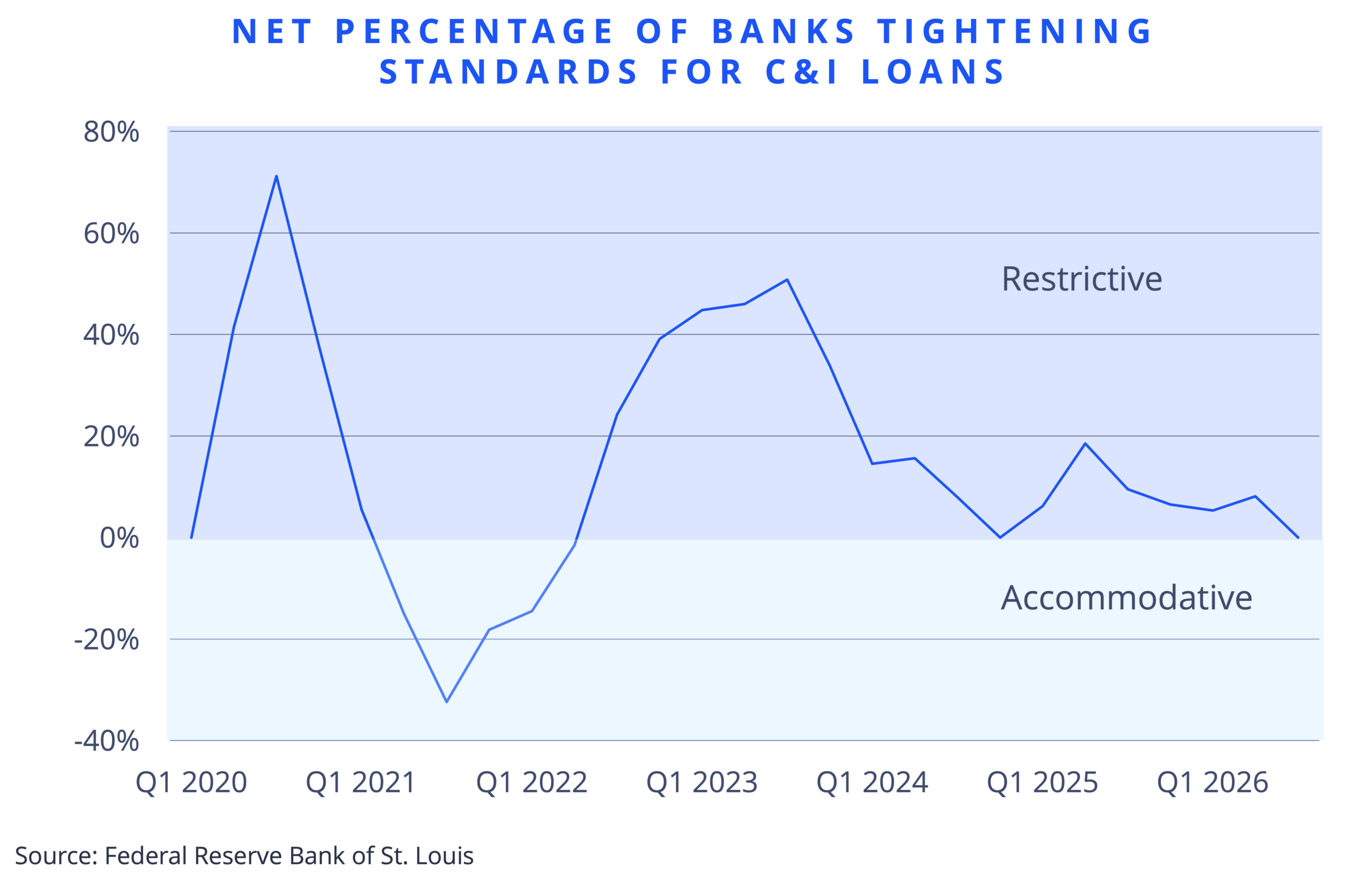
Large regional banks appear to be driving the early recovery. Trepp noted renewed commercial loan growth across a broad group of super-regionals in Q2, alongside rising net interest income and greater competition for commercial borrowers, suggesting lenders are shifting from balance-sheet preservation toward selective capital deployment.
Still, the recovery is not universal. Trepp describes the market as a “tale of two books,” with lenders originating new loans while managing stressed legacy assets. The SLOOS also points to a gap in credit access between larger and smaller borrowers. For investors, financing should remain most accessible for institutional-quality assets, experienced sponsors, and sectors with strong fundamentals.
 Steig Seaward
Lending trends in Q2 point to a more supportive credit backdrop following an extended period of constrained debt availability.

 Rachael Rothman